Summary
I led a category-level search relevance project at Kroger that started with a user behavior gap we could see clearly in research. Customers shopping for ice cream often had strong flavor preferences, but our item data did not represent those preferences in a way the ranking system could use well. I partnered with merchandising, item data, and data science teams to build a classification-based enrichment model that added better flavor-level signals into ranking. The conversion lift was small in percentage terms, but the category volume was high, and the work drove an 11% revenue lift in ice cream.
Outcome Highlights
+11%
Ice Cream generated Revenue
+
Customer Alignment / Customer Satisfaction Survey
Repeatable Pattern
Repeatable Attribution Enrichment pattern established for other categories
Role and scope
This work happened while I was Senior Manager of Product for Search Backend and Infrastructure at Kroger.
It sat inside the larger search modernization effort, but the problem here was more specific. We had already made progress on semantic retrieval and ranking improvements. In categories like ice cream, we were still seeing relevance issues because the product data feeding those systems was missing important structure.
The problem
We had a mismatch between customer preference language and catalog attributes.
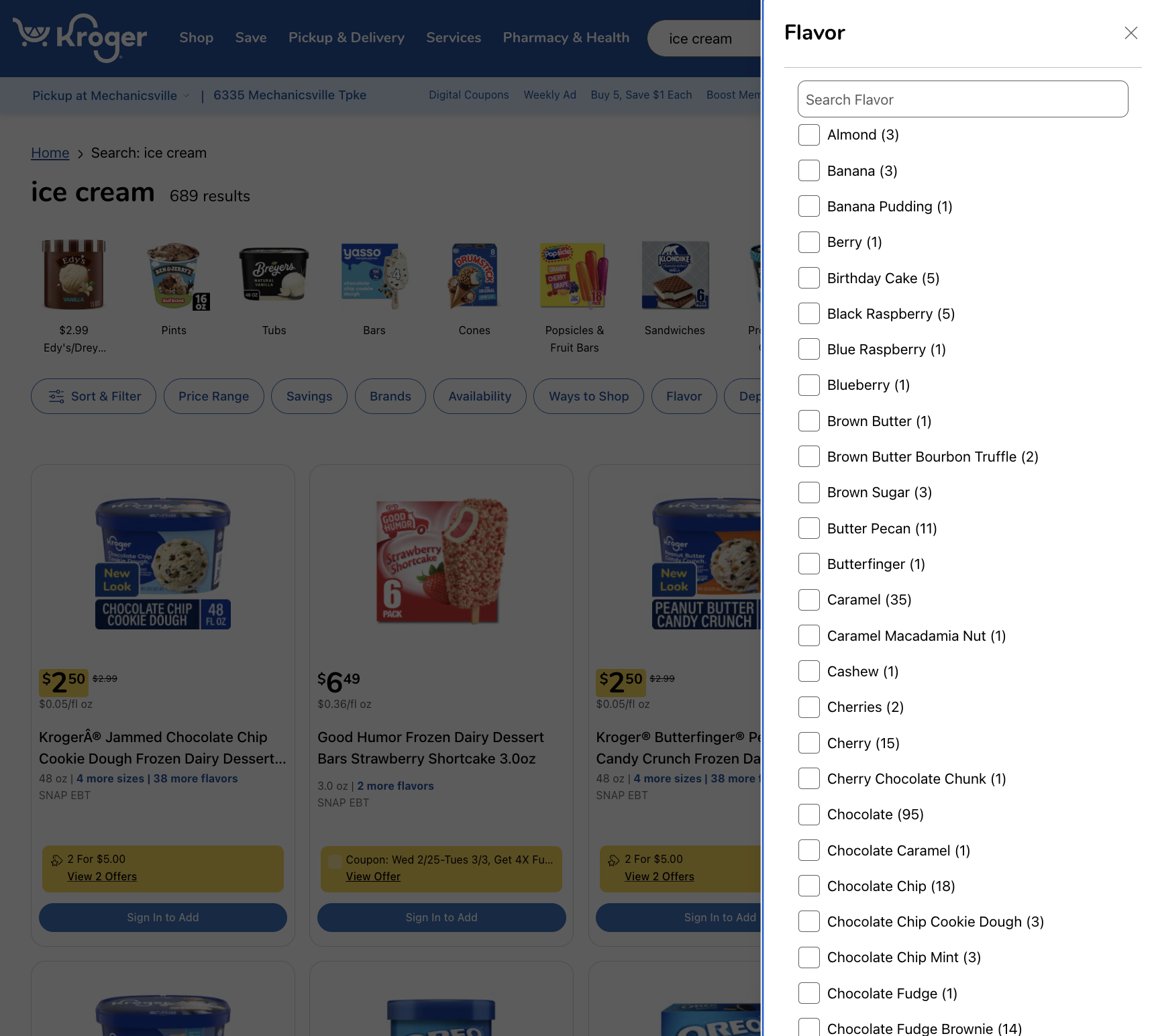
In user research, customers consistently showed strong flavor preferences. They might search broadly, but their decisions were often shaped by whether they wanted chocolate, vanilla, or another flavor family. Our catalog data usually captured branded flavor names like Rocky Road or Cherry Garcia, but it did not consistently capture the broader flavor categories customers were using to make choices.
That made the ranking signals weaker than they should have been in a high-volume category. We had better search infrastructure than before, but the data representation in this category was still working against us.
How we did it
1) Start from customer behavior
We grounded the work in user research and category behavior, not just search logs. The point was to make sure we were fixing the right problem.
The research gave us a clear direction. Customers were telling us how they shop for this category. We needed the data model to reflect that behavior more directly.
2) Partner across merchandising, item data, and data science
I worked with the merchandising team, item data team, and data science partners to define a data enrichment approach that could classify and normalize flavor-related product attributes into more useful preference groupings.
We kept the original catalog data intact and added enrichment on top of it. That helped preserve merchandising and brand accuracy while giving search and ranking systems a stronger signal to work with.
3) Feed the enriched attributes into ranking
Once the classification logic was ready, we integrated the enriched attributes into the Search filter capabilities.
This improved how the ranking system interpreted products in a category where preference clusters matter a lot. It also reduced the gap between branded flavor naming and how customers actually think.
Evaluating success
We evaluated this as a category-level relevance and business outcome improvement.
Category conversion and revenue impact
We measured performance in the ice cream category and looked at how the enriched attributes changed conversion behavior and category revenue.
Statistical significance at scale
The conversion movement was modest as a percentage, but ice cream is a top query and top category. With that level of traffic, the change was statistically meaningful and commercially important.
Relevance quality checks
We also reviewed whether the result set behavior matched the preference patterns we saw in research. That helped confirm we were improving the experience in a durable way.
Outcomes
This work improved category-level relevance by improving the quality of the data feeding the ranking system.
- 11% projected revenue lift in the ice cream category
- Better alignment between customer preference patterns and ranking features
- A repeatable approach for category-specific relevance improvements tied to user behavior
Leadership and org capability impact
This project required tight coordination across teams that usually work from different priorities.
Cross-functional alignment around a shared category outcome
Merchandising, item data, search product, and data science all needed to agree on the goal and the solution shape. I helped align the teams on improving category relevance while preserving catalog integrity and brand accuracy.
A repeatable pattern for relevance work
This project helped establish a stronger pattern for future search improvements:
- start with user behavior
- identify where the data representation is weak
- enrich the source signals
- then tune the search filter/facet system
That pattern made later conversations faster because we were not defaulting to “change the model” every time.
What I’d build on next
If I expanded this work, I would keep going category by category in places where customer preference is strong and the catalog representation is inconsistent. I would also build more reusable enrichment workflows so category teams and search teams could move faster together.